Why Your Oven Temperature Is Wrong and How to Fix It in Barrie
Last updated: August 11, 2026
Your oven says 375 F. Your baked chicken comes out raw in the middle or your cookies come out charred on the bottom. If your oven temperature is not accurate, you are not imagining things – and you are far from alone. Temperature drift is one of the most common appliance complaints we see at Max Appliance Repair Barrie, serving homes across Barrie and Simcoe County.
The good news: most causes are diagnosable in 20 minutes, and some are free to fix yourself. This guide walks through every culprit, from a simple calibration tweak to a failing thermostat, so you know exactly what you are dealing with before you call anyone.
How to test your oven temperature accurately
The display on your oven is not a thermometer. It shows you the setpoint – the temperature your oven is trying to reach – not the actual air temperature inside the cavity. Those two numbers can differ by 25 to 75 degrees Fahrenheit in a perfectly normal oven, and by much more in one that needs service.
The only reliable test is a standalone oven thermometer. You can pick one up at any kitchen store for $10 to $20. Place it on the centre rack, set the oven to 350 F, and wait a full 20 minutes after the preheat signal. Read the thermometer three times over the next 20 minutes and average the readings. If the average is more than 25 F off the setpoint in either direction, something needs attention.
Write down the actual readings. If you end up calling a technician for oven repairs, that data cuts diagnosis time in half.
Calibration drift: the free fix most homeowners miss
Every oven – gas or electric – has a built-in calibration offset you can adjust without any tools. Over time, the electronic setpoint drifts slightly from the factory default. If your thermometer test shows a consistent 25 to 35 F difference in the same direction every time, calibration drift is the most likely explanation.
Most modern ovens let you offset the temperature by up to 35 F in either direction. The procedure varies by brand:
- GE and Hotpoint: press and hold the Bake button for 5 seconds until “CAL” appears, then use the arrow keys to adjust.
- Whirlpool and KitchenAid: press Bake, then Bake again within 4 seconds; the display shows the offset.
- Samsung: go to Settings, then Oven Calibration from the control panel.
- LG: press Settings and scroll to “Oven Temperature Adjustment.”
If your oven is reading consistently cold, add degrees to the offset. Consistently hot? Subtract. This fix costs nothing and takes under two minutes. If the offset is already at the maximum and your oven is still wildly off, you have a hardware problem – keep reading.
A failing door gasket is leaking your heat
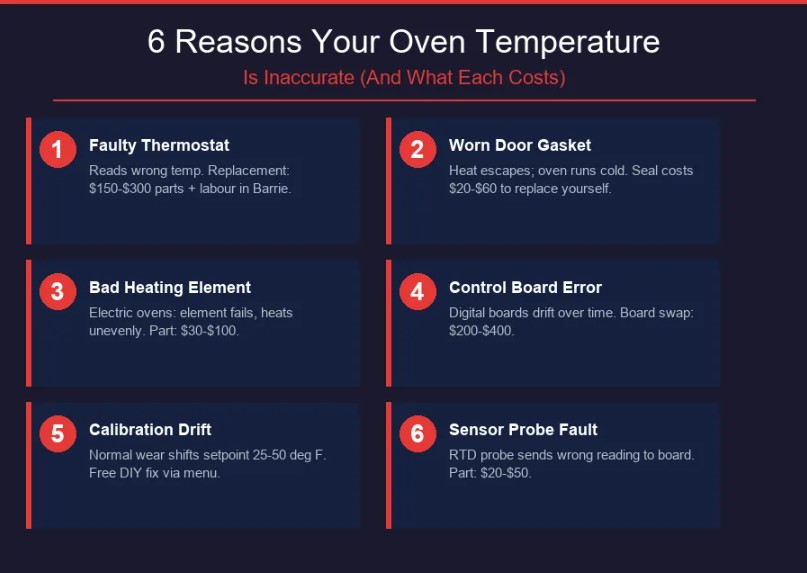
The rubber or silicone seal running around the perimeter of your oven door has one job: keep hot air inside the cavity. When it cracks, compresses, or tears, heat escapes during every bake cycle. The oven has to work harder to maintain temperature, cycling on and off more frequently, which means the temperature inside fluctuates instead of holding steady.
Testing is simple. Hold your hand a few centimetres from the door edge while the oven is at temperature. If you feel noticeable heat radiating outward, the gasket is suspect. You can also check visually – run your fingers along the gasket’s full perimeter. Any section that is compressed flat, torn, or brittle is no longer sealing properly.
Replacement gaskets for most major brands cost $20 to $60 and snap or clip into place without tools. This is one of the few oven repairs most homeowners can safely do themselves. For gas ranges, though, it is worth having a technician confirm there are no other issues while the door is off.

Bake and broil element failure
Electric ovens have two heating elements: the bake element on the bottom and the broil element at the top. Gas ovens have a burner assembly and igniter instead. When either fails partially, the oven heats unevenly or runs colder than the setpoint.
A visually failed element is obvious: you will see blistering, a crack, or a burn mark. But elements can also fail electrically without visible damage, reading open-circuit on a multimeter even though they look intact. If your oven is cold on the bottom rack but fine near the broiler, the bake element is the first thing to check. The reverse pattern – food burning on top – points to the broil element running even during bake cycles, usually from a relay stuck on the control board.
Replacement elements for common brands like Whirlpool, GE, Frigidaire, and Samsung typically run $30 to $100 for the part. Labour in the Barrie area adds another $80 to $150 depending on the repair complexity.
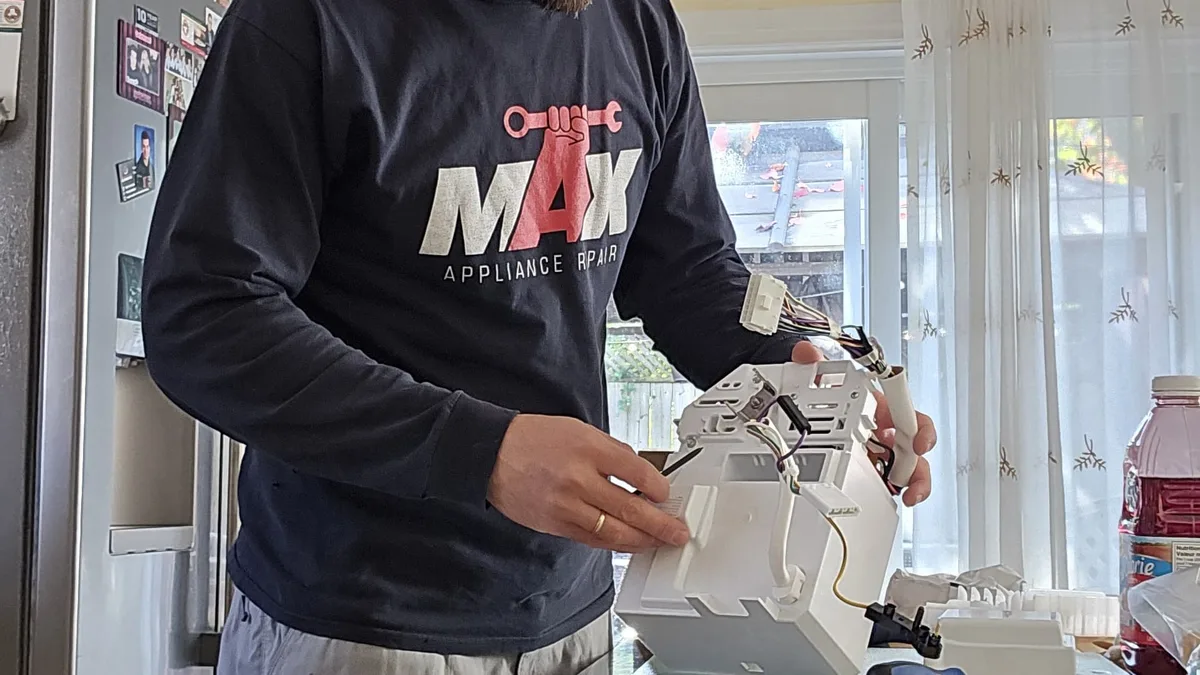
A Max Appliance Repair Barrie technician working on a dishwasher drainage issue.
Thermostat and sensor probe faults
Older gas ranges use a mechanical thermostat – a physical dial connected to a bulb-and-capillary assembly inside the oven cavity. When this wears out, the thermostat reads a temperature that no longer matches reality. The oven may overshoot consistently, under-heat, or cycle erratically between the two.
Modern electric and gas ranges instead use a resistance temperature detector (RTD) – a thin metal probe mounted to the back or top wall of the oven interior. This probe sends a resistance reading to the control board, which converts it to a temperature and adjusts the heat accordingly. If the probe develops a fault – a break in the wire, a loose connection, or internal corrosion – the board receives a false reading and heats to the wrong temperature.
Testing the RTD probe requires a multimeter. At room temperature, a functioning probe should read approximately 1080 to 1100 ohms. A reading far outside that range – or an open circuit reading – means the probe needs replacement. Parts typically cost $20 to $50. This is a DIY-friendly repair on most models, but if you are unsure about working inside an appliance, a technician can do it in under 30 minutes.
When the control board is the problem
The electronic control board is the brain of a modern oven. It receives temperature readings from the probe, manages the relay that controls the heating element or gas valve, and runs the display. When the board develops a fault – from a power surge, a manufacturing defect, or simple age – it may misinterpret the probe reading and heat to the wrong temperature.
Control board failure is a diagnosis of exclusion: you rule out the probe, elements, gasket, and calibration first. If everything else checks out and the oven still reads wrong, the board is suspect. Watch for secondary symptoms: inconsistent error codes, a display that resets randomly, or relay clicks that do not correspond to the expected heating cycle.
Board replacement is not a DIY job for most homeowners. The board sits behind the rear control panel, involves multiple wiring harnesses with anti-static handling requirements, and needs firmware calibration to the specific oven model after installation. If you are in Barrie or surrounding Simcoe County, the most cost-effective path is a diagnostic call from a technician who can test components in sequence and give you a repair-vs-replace recommendation on the spot.
Repair or replace: a quick decision guide
The general rule of thumb in appliance repair is the 50% rule: if the repair cost exceeds 50% of the cost of a comparable new appliance, replacement starts to make economic sense. For ovens and ranges, that threshold typically looks like this:
| Repair type | Typical cost (Barrie) | Worth it if oven is under |
|---|---|---|
| Calibration adjustment | Free (DIY) | Always |
| Door gasket replacement | $20-$60 DIY / $120-$180 with labour | Any age oven |
| Heating element / RTD probe | $150-$280 with labour | Under 12 years |
| Thermostat replacement | $200-$350 with labour | Under 10 years |
| Control board replacement | $300-$500 with labour | Under 8 years, high-end model |
Cost estimates reflect typical Barrie-area pricing as of 2026. Actual costs depend on brand, model, and parts availability. Ask for an estimate before authorizing any repair.
If your oven is more than 15 years old and needs a board or thermostat, it is often more economical to put that money toward a new range. Modern induction and convection models have improved significantly in energy efficiency over the past decade. That said, a well-maintained stainless steel range from a quality brand can last 20 or more years – so age alone is not the whole story.
Not sure which direction makes sense? Call Max Appliance Repair Barrie for a diagnostic visit. We will give you a straight answer, not a upsell.
GE Appliances walks through the built-in temperature adjustment feature available on most modern ranges.
Download our step-by-step guide covering all six causes above – formatted for printing and posting in your kitchen.
Download the PDF GuideFrequently asked questions
How much does it cost to fix an oven that runs too cold in Barrie?
Why does my oven overshoot the temperature and then cool down before stabilizing?
Is an inaccurate oven temperature dangerous?
Can a technician fix an oven on the same day in Barrie?
My new oven is running hotter than the old one at the same settings. Is something wrong?
Max Appliance Repair serves Barrie, Innisfil, Alliston, Orillia, Wasaga Beach, Collingwood, Bradford, and communities across Simcoe County. Same-day appointments available six days a week.
When your oven temperature is not accurate and the free calibration fix does not solve it, our technicians carry the most common parts on the van. Book a service call today.