
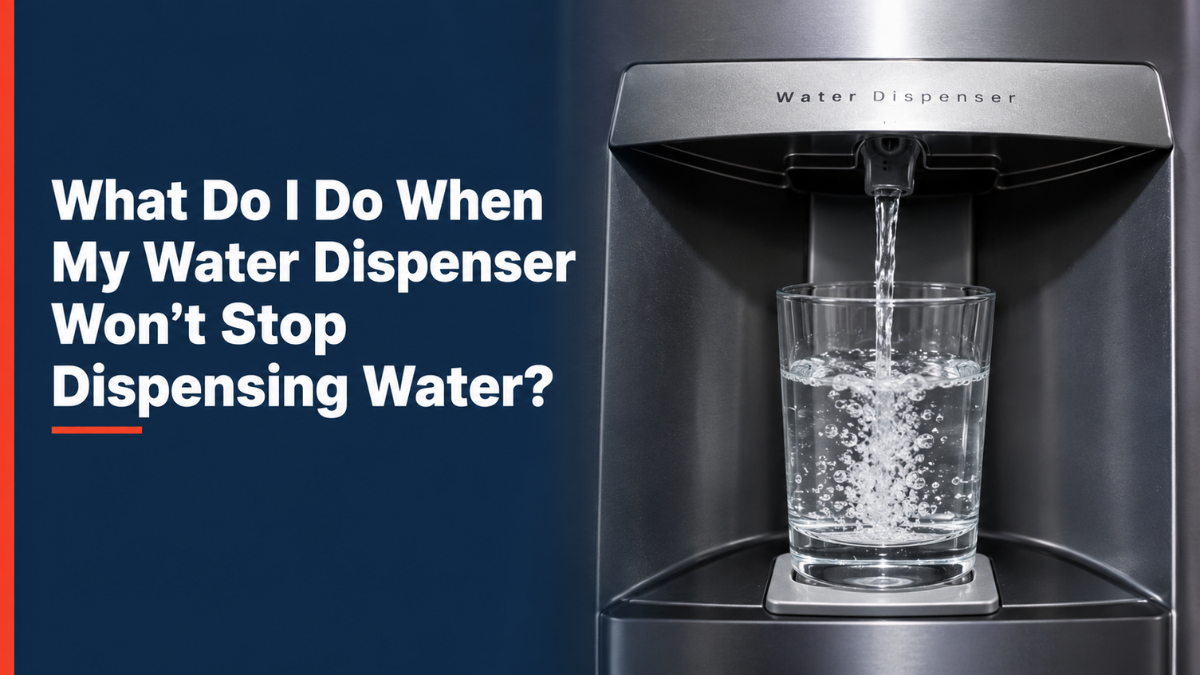
What Do I Do When My Water Dispenser Won’t Stop Dispensing Water?
Last updated: September 21, 2026
When we think about water dispensing problems, we usually picture a dispenser that has stopped working. The opposite fault is just as common and a lot messier: you let go of the paddle and the water keeps coming. Sometimes it is a steady stream, sometimes a drip that never quite stops, and either way you end up with a puddle on the kitchen floor. The good news is that only a handful of parts can cause it, and you can narrow the list down in a few minutes without any tools. Our Barrie team is also just a phone call away when you need professional repairs.
First, stop the water
Before you diagnose anything, cut the supply. Every fridge with a dispenser is fed by a small line from a shut-off valve, usually under the kitchen sink, in the basement below the kitchen, or behind the fridge itself. Turn a wheel valve clockwise until closed, or rotate a quarter-turn lever until it is perpendicular to the pipe. If you cannot find a dedicated valve, the main shut-off for the house works too. Then unplug the fridge or switch off its breaker. Doing both tells you something right away, and it gives you time to find the cause without catching water in a jug.
Work out which part is at fault
Check these in order. Each step rules something in or out, and you do not need to take the fridge apart for any of them.
1. The dispenser paddle or switch
Behind the paddle you push your glass against there is a small switch. When the paddle is pressed too hard, or something sticky has built up around it, the paddle can sit slightly forward and hold the switch closed. The fridge thinks you are still asking for water. Press the paddle firmly a few times and let it spring back. If the water stops when you unplug the fridge and starts again when you plug it back in, the switch is the first suspect, because the valve behind it only opens on an electrical signal.
2. The water inlet valve
The inlet valve sits at the back of the fridge, low down, where the supply line connects. It is an electrically operated valve (a solenoid) that opens when the switch asks for water and closes when you let go. Two things go wrong with it. Mineral scale or a bit of grit lodges in the seat and the valve cannot close fully, so it weeps. Or the internal seal wears and the valve stays open under line pressure even with no power. The test is simple: if the water keeps running with the fridge unplugged, the fault is mechanical and the valve has to be replaced. This is the most common cause of a dispenser that runs on its own.
3. A frozen or split line in the door
On a fridge with the dispenser in the freezer door, the water line runs through the door and can partially freeze. Water backs up behind the ice, then trickles out slowly for a long time after you let go. Signs are a weak stream, a delay after pressing, and a drip that eventually stops on its own. A line that has split from freezing will leak inside the door instead, and you will see water at the bottom of the door or under the fridge rather than at the spout.
4. The control board or wiring
If the paddle is free, the valve closes with the power off, and nothing is frozen, the signal itself may be stuck. A control board that keeps the valve energised, a chafed wire, or moisture in a connector can all do it. This one is not a job to chase yourself. Boards are expensive to guess at, and a technician can put a meter on the valve connector and know in a minute whether the board is holding it open.
What you can safely do yourself
Reset it. Unplug the fridge for five to ten minutes and plug it back in. A stuck electronic state clears on a lot of models, and it costs nothing to try.
Free the paddle. Wipe the area around the paddle and the switch with warm water, then work the paddle back and forth. If there is a cap over the switch, pop it off and clean behind it. A drop of food-safe lubricant on the pivot helps if it has gone stiff.
Purge the air. If your problem is a drip that lasts a few seconds after every glass, that is usually air in the line, not a fault. Run the dispenser for a solid two minutes into a jug. Trapped air escapes and the dripping settles down. If it does not, treat it as a valve problem.
Thaw the door line. Unplug the refrigerator and let the line thaw naturally. Follow the model-specific manual or request service (refer to Whirlpool guidance). Once water flows normally, check that the freezer is not set colder than it needs to be.
When to call for a repair
Any time the water keeps running with the fridge unplugged, the inlet valve needs replacing, and that means disconnecting the supply and getting behind the appliance. If the valve has failed, book a fridge repair in Barrie and we can usually be out the same day. The same inlet valve feeds the ice maker, so a fridge repair visit covers both: a valve that will not shut is frequently the same reason an ice maker overfills or freezes into a solid block.
Electrical faults are the other case. A loose wire or a board holding the valve open can do more damage the longer it runs, and diagnosing it means opening panels with the appliance live. Leave that to someone with a meter and the wiring diagram.
While you wait, you do not need to keep the fridge off. Leave the water supply valve closed, plug the fridge back in so your food stays cold, and the dispenser simply will not run until the technician arrives.
Frequently asked questions
Why does my fridge water dispenser keep running after I let go?
The dispenser switch behind the paddle is stuck closed, or the water inlet solenoid valve has failed open. Unplug the fridge. If the water stops, it is electrical and the switch is the first suspect. If it keeps running with the power off, the valve is stuck and has to be replaced.
Can I stop the water myself before a technician arrives?
Yes. Close the saddle valve or shut-off on the cold water line feeding the fridge, usually under the sink or behind the unit, then unplug the fridge. That stops the flow without touching the appliance internals.
Is a stuck water dispenser worth repairing?
Usually yes. A dispenser switch or an inlet valve is an inexpensive part and a short job on most fridges, so it is rarely the point where replacing the whole appliance makes sense.
When it comes to diagnosing water dispenser problems, it helps to have someone who has seen the fault before. No matter the brand or model of your fridge, our Barrie appliance repair technicians at Max Appliance Repair are happy to help. We understand how urgent a leak is and we offer prompt service and on-site repairs across Barrie and Simcoe County.