Why Is My Espresso Machine Not Pumping Water?
Last updated: August 11, 2026
Your espresso machine’s pump is running – you can hear it – but no water is coming out. That gap between a working pump and zero water output narrows down to about six causes, most of which you can diagnose and fix at home. This guide walks through each one in order of likelihood so you can get your machine working again without paying for a service call you might not need. If none of the fixes here solve it, that is when a espresso machine repair visit makes sense.
Barrie’s water tends to be moderately hard, particularly in older parts of the city on the municipal system and especially for well-water homes in surrounding Simcoe County communities. That hardness accelerates limescale buildup inside espresso machines significantly – making the issues covered here more frequent than they would be in softer-water areas.
How the pump in your espresso machine works
Most home espresso machines use a vibratory pump – a small electromagnetic piston that moves back and forth at 50 or 60 times per second, pushing water from the reservoir through the heating system and out through the group head at 9 bars of pressure. When the pump runs but produces no water, the problem is almost never the pump motor itself. It is something blocking or bypassing the water path between the reservoir and the group head.
The water path in a typical machine goes: reservoir – inlet valve – pump – boiler or thermoblock – solenoid valve – group head – portafilter. Any blockage or failure point in that chain produces the same symptom: pump noise, no water output.
Air lock – the most common culprit
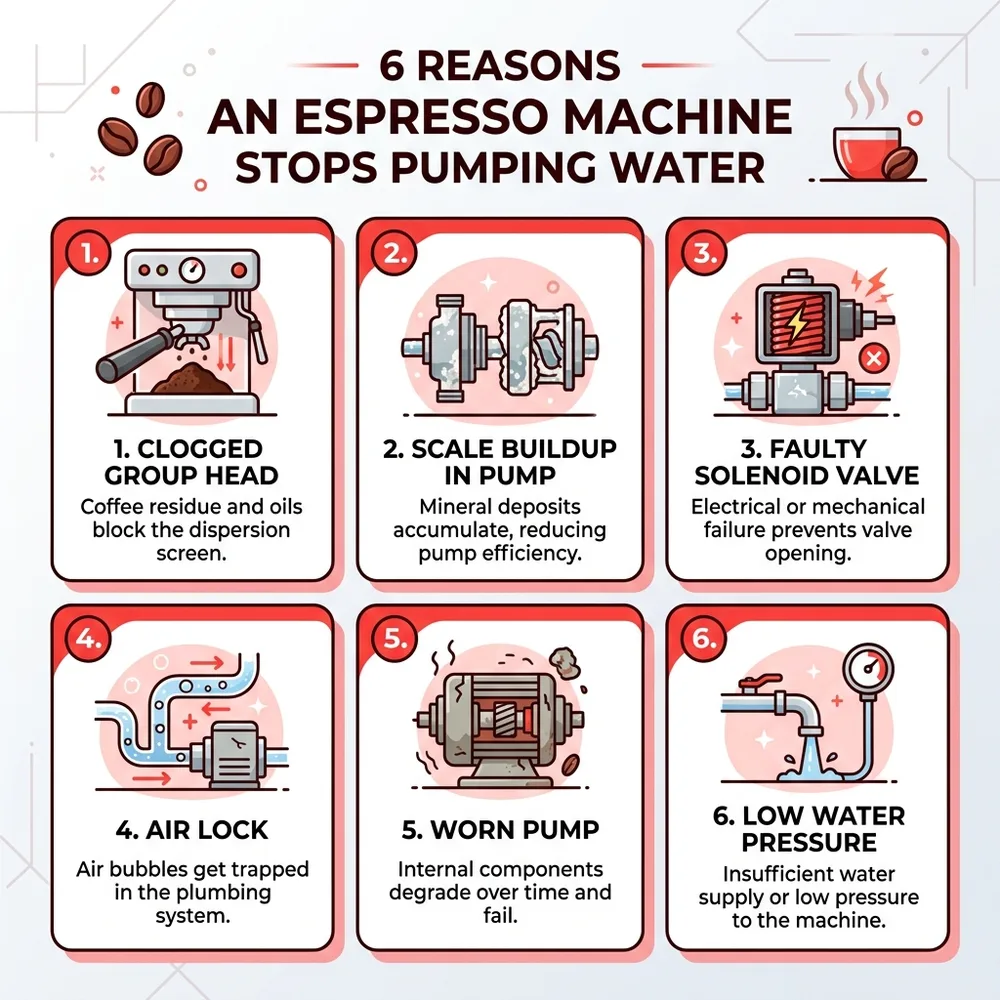
An air lock happens when a pocket of air gets trapped inside the pump or water lines. The pump cannot compress air the way it compresses water, so it runs but moves nothing. This is extremely common after the machine sits unused for a week or more, after you run the reservoir completely dry, or after replacing a water filter.
The fix is simple. Remove the water tank, empty it completely, and refill it. Tilt the machine gently to one side – this shifts any trapped air in the internal lines. Some machines have a steam wand or hot water tap on the front panel. Open it fully for 30 seconds while the pump is running. The steam wand path has a different route through the machine than the group head, and running water through it often dislodges an air lock. Then try pulling a shot normally.
Scale buildup and mineral clogging
Limescale – the white crusty deposit left behind when hard water evaporates – accumulates inside boilers, thermoblock heating elements, and internal valves. Given that Barrie’s water hardness typically runs between 120 and 180 mg/L depending on the distribution zone, a machine used daily without descaling will develop significant internal deposits within 3 to 6 months.
When scale builds up enough in the thermoblock or boiler, it physically reduces the internal diameter of the water path – eventually restricting flow to the point where the pump cannot push water through at all. The pump runs, pressure builds momentarily, and then stops because there is nowhere for the water to go.
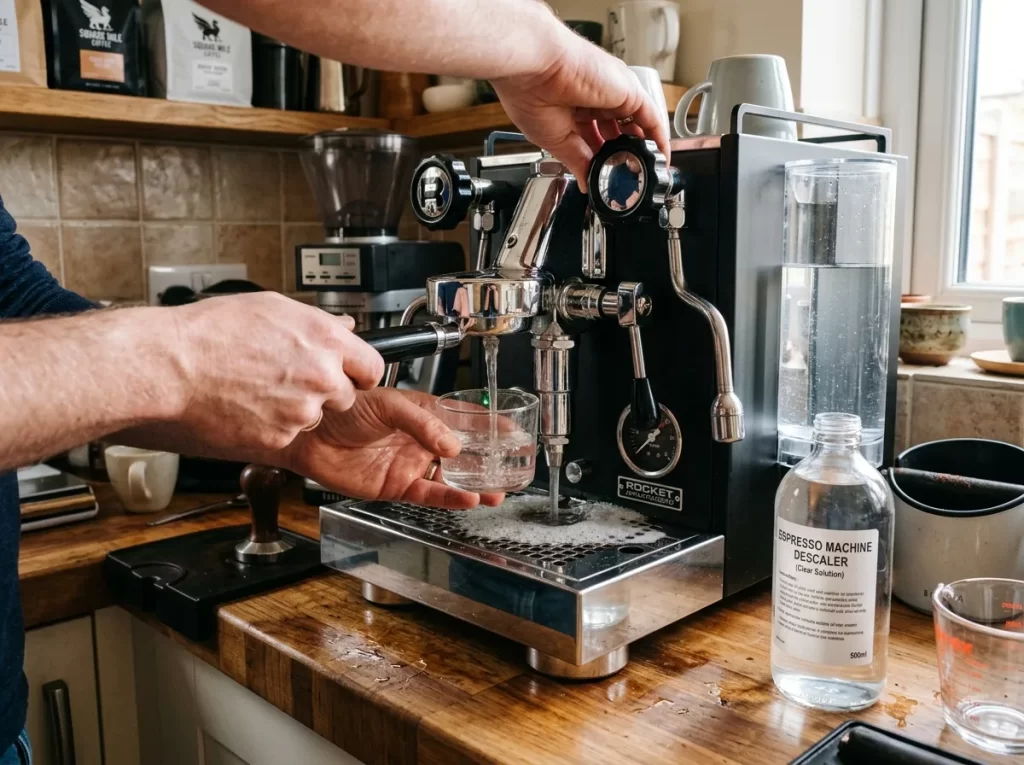
Descaling is the fix. Use a commercial espresso descaler (citric acid or proprietary solution – not white vinegar, which can leave its own residue and damage rubber seals). Follow your machine’s specific descale cycle if it has one – most modern machines have a dedicated descale mode. If not, run a solution of 1 tablespoon of citric acid dissolved in 1 litre of water through a full tank cycle at least twice. After descaling, run 2 to 3 full tanks of clean water through to flush out the solution.
Solenoid valve and group head blockages
The solenoid valve controls water flow between the pump and the group head. On three-way solenoid machines (most pump espresso machines made after 2015), the solenoid opens when you start a shot and closes when you stop. If the solenoid is stuck closed – from scale buildup, a failed coil, or a piece of debris – the pump runs but no water reaches the portafilter.
A stuck-open solenoid is also a problem but has a different symptom: water drips continuously even when you are not running the machine. A stuck-closed solenoid produces exactly what you described – pump running, no output.
On most machines, you can access the solenoid valve by removing the service panel. The coil connection can be checked for continuity with a multimeter. A failed coil reads infinite ohms – replacement coils for common machines (DeLonghi, Gaggia, Breville) typically run $20 to $50. If the coil is fine but the valve body is physically stuck from scale, soaking it in warm descaling solution for an hour often frees it.
When the pump itself has failed
True pump failure is less common than the issues above, but it does happen – usually after 8 to 12 years of daily use. A failing vibratory pump often makes a noticeably different sound: lower, laboured, or irregular rather than the sharp rapid staccato of a healthy pump. Sometimes it makes no sound at all if the coil has completely failed.
Vibratory pump replacements are straightforward – the pump is held in by two screws and two rubber mounts, with push-fit connections on the inlet and outlet sides. Pump prices for standard ULKA and Invensys units run $15 to $35. The repair takes about 30 minutes with basic tools. That said, if your machine is older than 10 years, consider whether a pump replacement makes financial sense compared to the cost of a new machine.
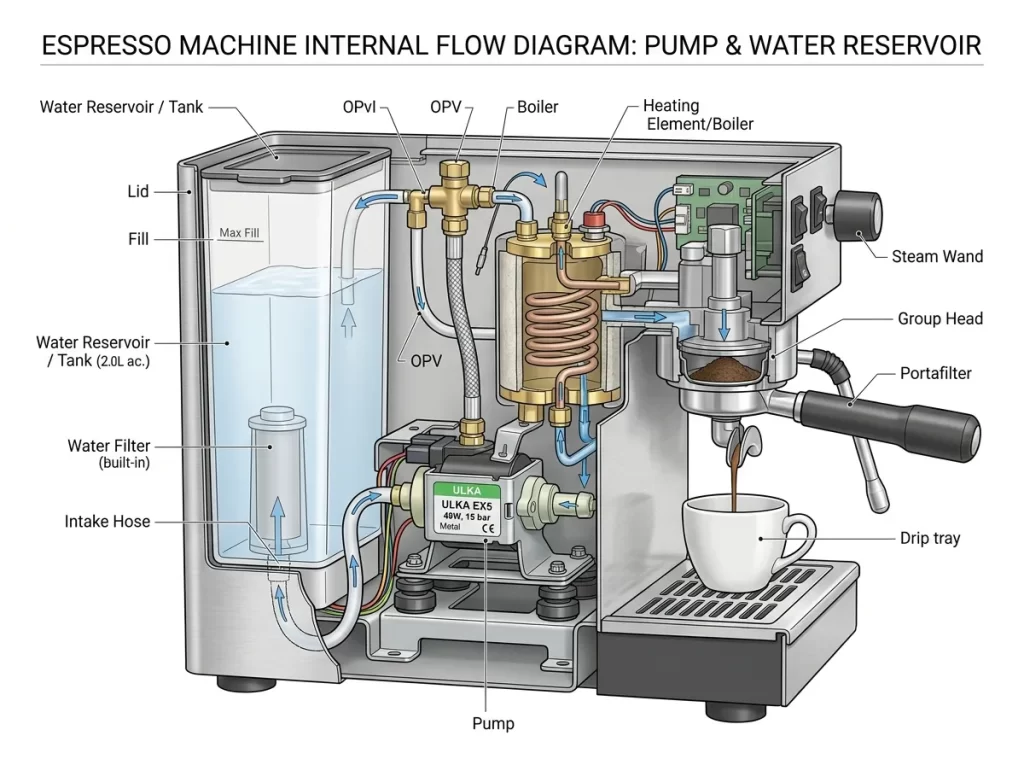
Step-by-step: what to try before calling a tech
Work through these in order. Most pump issues resolve somewhere in steps 1 through 4.
- Check the water reservoir is full and properly seated. An almost-empty tank causes an air intake. Remove, refill completely, and reseat firmly.
- Run the steam wand or hot water tap. Dispense through the wand for 30 to 60 seconds while the pump is active. This clears most air locks.
- Tilt the machine. With the tank removed, tilt the machine 30 degrees in each direction for a few seconds. Refill and retry. Shifts trapped air pockets.
- Run a descale cycle. Use a citric acid solution or manufacturer descaler. Run the full tank through twice, then flush with two full tanks of clean water.
- Check the group head screen. Remove the portafilter and look at the group head shower screen from below. A clogged screen severely restricts flow. Remove and soak in hot water with a bit of espresso cleaner for 20 minutes.
- Inspect the solenoid valve connection. If you are comfortable with the machine’s interior, check the solenoid coil connection for corrosion. A loose connection can prevent the valve from opening.
- If none of the above work, the pump or solenoid likely needs replacement. At this point, a tech diagnosis makes sense.
When to call for appliance repair in Barrie
If the machine is still under warranty, contact the manufacturer before opening any panels – disassembly typically voids coverage. For out-of-warranty machines, the practical cutoff is whether the repair cost approaches the replacement cost. For a high-quality prosumer machine worth $500 or more, a pump or solenoid replacement is almost always worthwhile. For a $150 entry-level machine, the math may not work out.
Max Appliance Barrie provides espresso/ coffee machine repairs mostly on the same day. If you have worked through the steps above and the machine is still not pumping water, give us a call. We will diagnose the issue and give you an honest assessment of whether repair or replacement makes more sense for your specific machine. We serve Barrie, Innisfil, Angus, Orillia, and the broader Simcoe County service area.
Frequently asked questions
Sources and references
Need appliance repair in Barrie?
Max Appliance Barrie serves Barrie, Innisfil, Angus, Orillia, and Simcoe County.
Book a repair today