Dishwasher Not Draining? A Barrie Homeowner’s Troubleshooting Guide
Last updated: August 11, 2026
You open the door after a full wash cycle and there it is – an inch of murky grey water sitting in the bottom of your dishwasher. A dishwasher not draining is one of the most common appliance calls we receive at Max Appliance Repair Barrie, and the good news is that roughly 70% of cases have a cause you can fix yourself in under 15 minutes. The other 30% need a part, and knowing which category you are in saves you time and a service call.
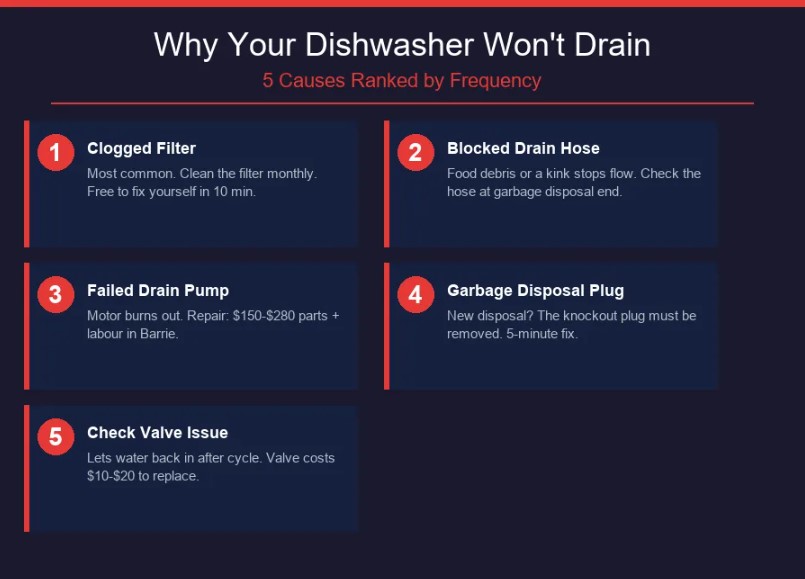
This guide works through the five most likely causes in order of frequency – starting with the most common and ending with the one that requires a technician. Work through them in sequence before calling anyone.
The clogged filter (fix this first – it’s free)
Most dishwashers made after 2010 have a manual filter at the bottom of the tub that you are supposed to clean every month or two. Most people never do. When this filter clogs with food particles, grease, and debris, water cannot pass through to reach the drain pump – so it sits in the tub.
To clean it: remove the lower rack, find the cylindrical filter assembly in the centre or back of the tub floor, twist it counterclockwise to release it, and pull it out. Rinse it under warm running water while scrubbing gently with a soft brush or toothbrush. Clear any debris from the flat mesh filter underneath it as well. Reinstall both, run a short cycle, and check whether the water drains.
If cleaning the filter fixes the problem, set a reminder to clean it monthly. A clogged filter also forces the drain pump to work harder than it should, shortening its lifespan significantly.
A blocked or kinked drain hose
The drain hose carries water from the drain pump to either the garbage disposal or the sink drain tailpiece under your counter. It is usually a corrugated plastic hose, roughly 1.5 to 2 centimetres in diameter. Two things go wrong with it: it gets kinked (especially if the dishwasher was recently moved or reinstalled), or it develops a clog at the connection points.
Pull the dishwasher out slightly from the cabinet and trace the drain hose from the back of the machine to where it connects under the sink. Look for any sharp bends or spots where it is pinched against a cabinet wall. A kink is easy to see and easy to fix – straighten the hose and secure it with a hose clamp if needed to keep it in position.
Clogs typically occur at the garbage disposal end or at the sink drain tailpiece. Disconnect the hose at the disposal side (have a bowl ready – water will come out) and check that the opening is clear. Also confirm that the drain hose has the correct high loop or an air gap installed. Without a high loop, grey water from the sink can siphon back into the dishwasher tub during the drain cycle, which means the machine appears to not drain even though it does drain – it just fills back up immediately.
Garbage disposal issues
If your dishwasher drains into a garbage disposal, the disposal needs to be clear before the dishwasher can drain. A disposal that is full of food, jammed, or not fully installed can block the dishwasher drain completely.
Run the disposal for 15 seconds before starting the dishwasher. If the disposal is jammed, use the reset button on the bottom of the unit and an Allen key in the centre hex socket to free the grinding plate before running it.
If your disposal was recently replaced, there is one specific thing to check: the knockout plug. New disposals ship with a plastic plug in the dishwasher drain inlet port. If you connected your dishwasher hose without removing this plug, water has nowhere to go. Disconnect the hose, look inside the disposal inlet, and use a screwdriver and hammer to knock the plug into the disposal, then retrieve it from the grinding chamber before running the disposal again. This is a five-minute fix that people miss because the instructions are on page 8 of the manual nobody reads.
A failed drain pump
If the filter is clean, the hose is clear, and the disposal is fine, the drain pump is the next suspect. The drain pump is an electric motor that forces water up and out through the drain hose. When it fails, you will often hear a humming sound at the end of the cycle – the motor trying to run but unable to move water – before silence and standing water.
Drain pumps fail from three main causes: foreign objects getting past the filter and jamming the impeller, the motor winding burning out from running dry, and bearing wear from years of use. The first cause – a jammed impeller – is sometimes fixable by accessing the pump from inside the tub (after removing the filter assembly) and clearing whatever is blocking the rotating impeller. A pair of needle-nose pliers and a flashlight are all you need. Be prepared to find a piece of broken glass, a small bone, or a food wrapper that made it past the filter.
A burned-out motor or worn bearings require pump replacement. This involves pulling the dishwasher out from the cabinet, disconnecting the water supply and drain hose, tilting the unit on its side to access the underside pump mount, and replacing the assembly. It is a repair most comfortable homeowners can handle, but it takes about 90 minutes if you have not done it before. Drain pump parts for major brands – Bosch, Whirlpool, Samsung, LG, Frigidaire – typically run $80 to $150. Labour adds $100 to $180 in Barrie depending on the model’s accessibility.
The check valve and drain solenoid
Some dishwashers use a check valve at the end of the drain hose or at the pump outlet to prevent drain water from flowing back into the tub after the cycle completes. When this valve sticks open, water that the pump successfully drains out comes right back in during the wash phase. The symptom is subtle: the dishwasher drains, but by the time the cycle finishes, there is water on the tub floor again.
Check valves are typically small plastic flap or ball-and-seat assemblies that cost $10 to $20 to replace. They are accessible from inside the sump area in most models once the filter is removed.
Older dishwashers use a solenoid-operated drain valve instead of a pump-driven system. The solenoid energizes during the drain cycle to open a valve that allows water to flow out under gravity. A failed solenoid means the valve never opens. If you hear a click but no draining, this is worth checking. Solenoids are usually $20 to $50 for the part.
When to call a technician in Barrie
Call a technician when: the filter is clean, the hose is unobstructed, the disposal is clear, and you still have standing water after a cycle. At that point, the problem is inside the machine – pump motor, check valve, solenoid, or in some cases a control board drain relay – and diagnosing it correctly requires the right tools and the willingness to get the dishwasher out of the cabinet.
Max Appliance Repair serves Barrie, Alliston, Innisfil, Orillia, and surrounding Simcoe County communities. We stock drain pump assemblies for the most common brands on the service van, so most repairs happen on the first visit. Book a same-day dishwasher repair today.
Note: Any costs provided in this article only depict industry average. Get a Quote for your appliance repair now!
The Home Depot walks through four practical steps for diagnosing a dishwasher that won’t drain, including filter access and drain hose inspection.
Download our six-step checklist to print and keep under the sink. Covers filter cleaning, hose inspection, disposal checks, and pump testing.
Download the PDF ChecklistFrequently asked questions
How much does dishwasher drain repair cost in Barrie?
Is it normal to have some water in the bottom of a dishwasher after a cycle?
Why does my dishwasher drain but then fill back up with water?
My dishwasher hums at the end of the cycle but doesn’t drain. What’s wrong?
Can a dishwasher drain problem damage the machine or my kitchen?
Keep reading
Why your dishwasher stops mid-cycle and how to diagnose each cause systematically.
The 50% rule and practical decision matrix for every major household appliance.
The most frequent fridge failures Barrie homeowners encounter and what each one means.